
Warrant Records serve as the primary gateway for anyone needing instant access to Fairfax County’s legal filings, and the online portal simplifies every step from a simple warrant lookup to a full background check. By entering the warrantrecords login on the official website, users can perform a warrantrecords online search that returns arrest warrant lookup results, misdemeanor records, and felony warrant search details in seconds. The system also supports a warrantrecords case status check, letting you see if a warrant is active, served, or recalled without waiting for a clerk’s assistance. For deeper investigations, the warrantrecords documentation request feature lets you download PDF copies of court records, while the warrantrecords subpoena process guides you through legal requests for sealed or archived files. Whether you’re verifying a criminal history, confirming a court record, or needing a comprehensive record retrieval guide, the platform’s intuitive design matches user intent with precise, authoritative data.
Warrant Records also integrate tools for broader public record research, such as warrantrecords inmate lookup and warrantrecords background check services that pull from multiple databases. The portal’s search filters let you explore records by name, warrant number, case number, date of birth, issuing authority, or warrant type, ensuring you locate the exact entry you need. Alongside the standard warrantrecords fees disclosure, the site clarifies costs for PDF download, documentation requests, and any additional charges for accessing historical or sealed records. By consolidating warrantrecords public records, court records, and criminal history into a single, user‑friendly interface, the service eliminates the guesswork of multiple agency visits and delivers reliable information straight to your screen.
How to Search Warrant Records
You can search Warrant Records through the Fairfax County Sheriff’s Office online portal, which gives you direct access to active warrants issued within the county. The system is designed for both residents and outside parties who need to verify legal status, perform a background check, or confirm a criminal history. Each search returns public information maintained by the Fairfax County courts and law enforcement agencies. Results are sorted by relevance and present the subject’s name, warrant type, issuing authority, and current status in a clean, readable format.
Official Search Portal: https://fairfaxcounty.gov/sheriff/warrants
Steps to Search
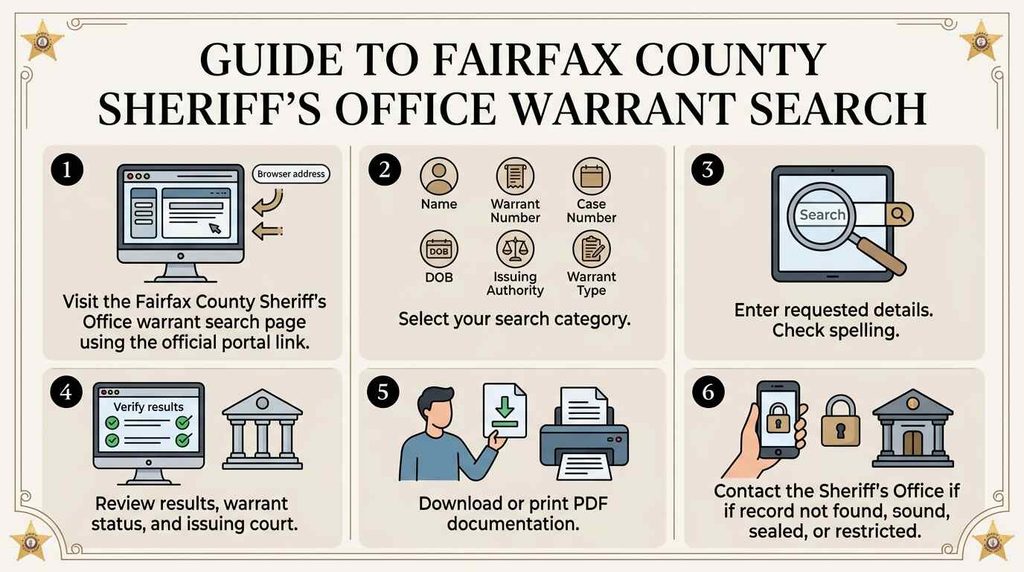
- Visit the Fairfax County Sheriff’s Office warrant search page using the official portal link.
- Select your search category: name, warrant number, case number, date of birth, issuing authority, or warrant type.
- Enter the requested details in the appropriate field and confirm spelling matches official documents.
- Review the on-screen results to verify the subject, warrant status, and issuing court.
- Download or print a PDF copy if you need documentation for legal, employment, or personal reference purposes.
- Contact the Sheriff’s Office directly if the record is sealed, restricted, or does not appear in your results.
Fairfax County Warrant Records Search
Fairfax County Warrant Records are organized through several search filters that help you narrow down results based on the data you already possess. Each filter pulls from the same central database maintained by the Sheriff’s Office, which records updates from the General District Court, Circuit Court, and Juvenile Court. You can switch between filter types without reloading the page, and the portal remembers your last query for quick reference. This design reduces the time spent searching across separate agencies and gives you one consolidated view of all active and historical entries.
Search by Person Name
Searching by person name is the most common method for performing a warrant records online search. You can enter the full legal name or just the last name with a first initial to broaden the results. The system returns all matching entries, sorted by date issued. If multiple individuals share the same name, you can use additional filters such as date of birth or warrant type to isolate the correct record. This method works well for personal verification, family research, and basic background checks.
Search by Warrant Number
Searching by warrant number is the fastest way to retrieve a specific record when you already have the unique identifier. The warrant number is a string of characters assigned at the time of issuance and never changes throughout the life of the warrant. Entering this number returns the exact entry along with the subject’s name, charge description, and current status. This method is useful for legal professionals, employers, and individuals who have received a court document with the warrant number listed.
Search by Case Number
Searching by case number links the warrant directly to the underlying court case file. Each case number is tied to a specific court division, and the portal will display all warrants associated with that docket. This includes active warrants, served warrants, recalled warrants, and any quashed or expired entries. Attorneys, paralegals, and self-represented litigants rely on this filter to cross-reference court records and confirm whether a warrant is still enforceable.
Search by Date of Birth
Searching by date of birth helps you confirm the identity of the subject when names are common or repeated across multiple entries. Combining a full name with a date of birth narrows the result set significantly and reduces the risk of false matches. This filter is often used in employment screenings, tenant background checks, and adoption or foster care applications where exact identity matters.
Search by Issuing Authority
Searching by issuing authority shows you all warrants issued by a specific judge, court, or law enforcement unit. Common issuing authorities in Fairfax County include the General District Court, Circuit Court, Juvenile and Domestic Relations District Court, and the Magistrate’s Office. This filter is helpful when you need to confirm which court signed off on a warrant, especially during appeals or judicial review.
Search by Warrant Type
Searching by warrant type groups results by category, such as arrest warrant, bench warrant, failure-to-appear warrant, or probation warrant. This filter is useful when you are looking for a specific class of legal action rather than a named individual. You can pair the warrant type filter with a date range to see how many warrants of that category were issued in a given month or year.
Warrant Record Details
Each warrant record displayed on the Fairfax County portal contains a standardized set of fields that identify the subject, the nature of the warrant, and its current standing. These fields are drawn from the original court filing and updated each time the warrant changes status. Understanding what each field means helps you interpret the results correctly and avoid confusion with similar records. The table below summarizes the core data points you will encounter during a typical search.
Warrant Number
The warrant number is the permanent identifier that stays with the record from issuance through final disposition. Court clerks assign this number using a format that includes the year and a sequence code. The warrant records login system uses this number to pull the full record from the database in real time. Even if the warrant is served, recalled, or quashed, the number remains the same and serves as a reference point in all future documentation requests.
Subject Name
The subject name field lists the full legal name of the person named in the warrant. This name is taken from the charging document and may include aliases or known variations. The portal displays all name variants so you can confirm the correct person, especially when there are multiple people with similar names. Legal name changes, marriages, and corrections issued by the court are updated on the portal within the same processing cycle.
Warrant Type
The warrant type classifies the legal action and determines the procedures that follow. Common types include arrest warrant, bench warrant, failure-to-appear warrant, and probation warrant. Each type carries different enforcement priorities and expiration rules. Knowing the type helps you understand the urgency of the warrant and what steps the subject must take to resolve it.
Issuing Authority
The issuing authority identifies the court, judge, or magistrate who approved the warrant. Fairfax County warrants are typically issued by the General District Court, Circuit Court, or the Magistrate’s Office. This field also records the jurisdiction, which is important when confirming that the warrant applies to a resident of Fairfax County or someone who committed an offense within its boundaries.
Issue Date
The issue date marks the day the warrant was signed and entered into the official record. This date determines the start of the warrant’s active period and is used to calculate time-sensitive legal deadlines. The portal updates the issue date if a clerical error is corrected through a formal amendment. Reviewing the issue date also helps you determine how long the warrant has been outstanding.
Warrant Status
The warrant status field shows the current state of the record, such as active, served, recalled, quashed, or expired. This is the field most users check first, because it determines whether law enforcement is still seeking the subject. The status is updated by the Sheriff’s Office and the issuing court as the case progresses. Refresh the page or re-enter the search to see the most recent status if you checked the record earlier.
Types of Warrant Records
Fairfax County processes several types of warrants, each tied to a specific legal circumstance. The type of warrant determines which court has authority, what enforcement actions can follow, and what the subject must do to clear the record. Below is an overview of the warrant types most commonly listed in the portal.
Arrest Warrants
Arrest warrants are issued when law enforcement presents probable cause to a magistrate or judge. They authorize the Sheriff’s Office or any peace officer in Virginia to take the named individual into custody. The warrant remains active until the subject is arrested, the warrant is recalled, or the case is dismissed by the court.
Bench Warrants
Bench warrants are issued directly by a judge, usually for failure to comply with a court order. They are common when a defendant misses a scheduled hearing or fails to follow the conditions of release. Once issued, a bench warrant stays active until the court vacates it or the subject appears in court.
Failure-to-Appear Warrants
Failure-to-appear warrants are a specific type of bench warrant triggered when a defendant does not show up for a scheduled court date. The court clerk enters the FTA, and the judge signs the warrant. Resolving this type of warrant typically requires the subject to appear before the issuing judge and explain the absence.
Probation Warrants
Probation warrants are issued when a probation officer alleges that the subject violated the terms of supervised release. These warrants may also be called violation warrants. After arrest, the subject is brought back before the sentencing court for a violation hearing, where the judge decides whether to reinstate, modify, or revoke probation.
Other Judicial Warrants
Other judicial warrants include search warrants, capias warrants, and detainer warrants. Each serves a distinct purpose in the legal process and is logged in the same database. Search warrants authorize law enforcement to enter a specific location, capias warrants order an arrest following a sentencing, and detainer warrants hold a subject in custody based on another jurisdiction’s request.
Warrant Status and Disposition
The status of a warrant changes throughout its life cycle based on court actions, law enforcement activity, and time limits. Fairfax County tracks these changes in real time and reflects them on the portal. The status field is the most frequently updated piece of information in any record, and it determines whether the warrant is still enforceable. Users performing a warrant records case status check rely on this field to confirm current standing.
Active Warrants
Active warrants are those that have been issued and have not yet been resolved. Law enforcement is authorized to arrest the subject at any time, and the warrant stays in this status until one of three things happens: the subject is taken into custody, the court recalls the warrant, or the warrant is quashed. Active warrants appear at the top of search results and are flagged for priority review.
Served Warrants
Served warrants are those that have been executed, meaning the named individual has been arrested or has appeared in court voluntarily. Once served, the warrant is no longer enforceable, but the record remains visible for historical reference. Served warrants are useful when you need to confirm that a past action was completed and that no new charges are pending.
Recalled Warrants
Recalled warrants are withdrawn by the issuing authority before they are served. Recalls often occur when new evidence clears the subject, when a clerical error is discovered, or when the prosecutor decides not to pursue the case. A recalled warrant no longer authorizes arrest, and the subject is free from the obligation to appear unless new charges are filed.
Quashed Warrants
Quashed warrants are canceled by a formal court order, typically after a defense motion or judicial review. You can also access bench warrants to review official records. The quashing process is more formal than a recall and usually involves a written order from the judge. Once quashed, the warrant is removed from active enforcement lists but remains in the historical archive for transparency.
Expired Warrants
Expired warrants are those that have passed their statutory validity period without being served. Certain warrant types in Virginia carry automatic expiration dates or are subject to dismissal motions after a set period. The portal shows expired warrants as inactive, and they cannot be used to justify an arrest.
Status Changes
Status changes occur whenever the court, the Sheriff’s Office, or the clerk’s office updates the record. Common triggers include new charges, court appearances, and case dismissals. The portal logs each change with a timestamp and the name of the official who made the update, giving you a clear audit trail for any record you review.
Warrant Record Identification
Correctly identifying a warrant record is critical, especially when the search returns more than one match. The Fairfax County portal includes several tools that help you confirm that you are viewing the right entry. The following sections explain how each identification method works and when to use it.
Matching the Correct Person
Matching the correct person requires cross-referencing the subject’s name with their date of birth, physical description, and known addresses. The portal displays all available data points in the record summary, so you can compare them with the information you have on file. When in doubt, contact the Sheriff’s Office for additional confirmation before taking any action based on the search results.
Matching the Warrant Number
Matching the warrant number is the most precise identification method. Since each warrant has a unique identifier, you can use the number to pull the exact record without any ambiguity. This is the recommended method for legal filings, employer background checks, and any situation where accuracy is paramount.
Identifying the Issuing Authority
Identifying the issuing authority helps you confirm that the warrant was issued by a Fairfax County court. Look for the court name, judge’s name, and jurisdiction listed in the record. If the issuing authority is outside Fairfax County, the record may belong to a different jurisdiction’s database, even if the subject resides in the county.
Confirming the Jurisdiction
Confirming the jurisdiction ensures that the warrant is enforceable within Fairfax County. The portal lists the jurisdiction at the top of each record, and you can compare it with the location of the alleged offense or the subject’s residence. Jurisdiction issues are common in cases where the subject lives near a county border or was charged in a different state.
Distinguishing Multiple Warrants
Distinguishing multiple warrants requires reviewing each entry’s warrant type, issue date, and charge description. A single subject may have several active warrants at once, often tied to different cases. The portal lists each warrant separately, and you can click on any entry to view the full record. Reviewing all entries gives you a complete picture of the subject’s legal standing.
Warrant Record Availability
Warrant record availability varies based on the record’s age, status, and whether the court has placed restrictions on public access. Fairfax County provides three broad categories of records, each with its own access rules. Understanding these categories helps you know what to expect when you perform a search.
Current Warrant Records
Current warrant records are those that are still active or have been served, recalled, quashed, or expired within the past few years. These records are fully searchable on the portal and include complete information about the subject, the charges, and the current status. You can view, download, and print these records without restriction.
Historical Warrant Records
Historical warrant records cover warrants that are older than the standard retention window but are still considered public. They appear in the portal with limited details, such as the subject’s name and the final disposition. Full record copies are available through a documentation request submitted to the Sheriff’s Office or the appropriate court clerk.
Archived Warrant Records
Archived warrant records are stored off the main database and are not searchable through the online portal. To view an archived record, you must submit a formal documentation request and pay any applicable fees. Archived records are often kept for legal reference and historical research, and they may require a waiting period before they are released.
Public Warrant Information
Public warrant information is the subset of warrant data that is always open to public view. This includes the subject’s name, warrant type, issuing court, and current status. Personal identifiers such as Social Security numbers, driver’s license numbers, and home addresses are removed to protect privacy while keeping the record useful for verification purposes.
Restricted Warrant Information
Restricted warrant information is data that the court has limited from public access. Common examples include warrants involving juveniles, sealed indictments, and ongoing investigations. Accessing restricted information typically requires a court order, a subpoena, or the consent of the named individual.
Sealed Warrant Records
Sealed warrant records are closed by a judge’s order and are not visible to the public. Law enforcement agencies may still act on a sealed warrant, but the details are not posted online. To view a sealed record, you must go through the warrant records subpoena process and demonstrate a legal basis for access.
Warrant Record Updates
Warrant record updates occur whenever a new event changes the status or details of an existing warrant. The Fairfax County portal reflects these changes in near real time, with most updates posted within 24 hours of the official action. The following sub-sections describe the most common types of updates.
Newly Issued Warrants
Newly issued warrants are added to the database on the same day they are signed by the judge or magistrate. You can also access wanted persons public records to review official records. If a warrant is issued after business hours, it typically appears the next morning. The portal flags new entries with a timestamp so you can see when the record first entered the system.
Served Warrant Updates
Served warrant updates are posted as soon as the Sheriff’s Office enters the arrest or court appearance into the system. The status field changes from “active” to “served,” and the record may include the date and location of the arrest. Served warrants remain visible for historical reference but no longer authorize new arrests.
Recalled Warrant Updates
Recalled warrant updates are posted when the issuing court withdraws a warrant before it is served. The status changes to “recalled,” and the record notes the reason for the recall when one is provided. Recalled warrants are searchable but are clearly marked so users do not mistake them for active entries.
Quashed Warrant Updates
Quashed warrant updates occur when a judge formally cancels the warrant. The status changes to “quashed,” and a notation references the court order that authorized the cancellation. Quashed warrants are kept in the database to provide a complete record of the case history.
Corrected Warrant Information
Corrected warrant information is posted when the court issues an amendment to fix a clerical error. Common corrections include misspellings, incorrect dates, and updated charge descriptions. Each correction is logged in the record’s history, so you can see the original entry and the amended version.
Removed or Archived Entries
Removed or archived entries are no longer visible on the public portal. Removal typically happens when a record is sealed by court order or when it has been archived according to the retention schedule. Archived records can still be requested through the documentation request process, but they require additional processing time and may carry higher fees.
Warrant Record Accuracy
Warrant record accuracy is maintained through a combination of court oversight, clerk review, and user reporting. Even so, occasional errors can appear in any large database. Fairfax County provides several tools that help you verify the data and report problems when you find them. Reviewing the following sections can help you confirm that the records you are reading are correct.
Verifying Warrant Information
Verifying warrant information starts with checking the warrant number against the official court document. If you have access to a citation, summons, or other paperwork, compare the details on the document with the portal entry. When the information matches, you can rely on the record. When it does not, contact the court clerk or the Sheriff’s Office for clarification.
Checking Current Status
Checking the current status is the most common accuracy check. The status field is updated in real time, so a fresh search gives you the latest information. If you have viewed a record in the past and the status has changed, the portal will display the new status along with the date of the change. Refresh the page to make sure you are looking at the most recent data.
Confirming Record Currency
Confirming record currency means checking when the record was last updated. The portal shows the last update date on each entry. Records that have not been updated in a long time may be archived or subject to retention rules. When you need the freshest data, perform the search just before you use the information.
Identifying Duplicate Entries
Identifying duplicate entries is important when the system returns more than one match for a single subject. Duplicates can occur when a name is entered with different spellings or when a case is reopened. Compare the warrant numbers, case numbers, and issue dates to determine which entries refer to the same event. If you find a true duplicate, report it to the Sheriff’s Office for removal.
Reporting Incorrect Information
Reporting incorrect information is straightforward and helps keep the database reliable. Each record on the portal displays a link or contact option for corrections. Submit the warrant number, the field that is incorrect, and the correct information, along with supporting documentation. The Sheriff’s Office reviews the request and updates the record when the correction is verified.
Search Problems
Even with a well-maintained database, search problems can occur. The most common issues involve timing, spelling, and jurisdiction. Knowing what to expect can help you troubleshoot quickly and avoid wasted time. The following sub-sections describe the most frequent problems and how to address them.
No Warrant Found
A “no warrant found” result means the database did not return a match for the search criteria you entered. This can happen if the subject has no active warrants, if the name is spelled differently than what is on record, or if the warrant has not yet been entered into the system. Try alternative spellings, add a date of birth, or search by case number when possible.
Similar Names
Similar names are one of the most common causes of confusion. When the search returns multiple results, review each entry carefully and use additional filters to narrow the list. Comparing the date of birth, address, and warrant type helps you confirm the correct subject before relying on the record.
Incorrect Warrant Number
An incorrect warrant number will return a “no results” page. Double-check the number against the original document, paying close attention to letters and numbers that look similar. If the warrant number is still not found, the record may belong to a different jurisdiction or may be sealed.
Recently Issued Warrant Not Listed
A recently issued warrant may not appear immediately if it was signed after business hours. The portal updates throughout the day, but a short delay of a few hours is normal. If the warrant is more than 24 hours old and still not visible, contact the Sheriff’s Office to confirm that the record has been entered.
Status Not Yet Updated
A status may not be updated if the court order has not been entered into the system. This delay is usually short but can last a few days in busy courts. If you need the most current status, contact the issuing court directly or wait 24 to 48 hours and re-run the search.
Recalled Warrant Still Appearing
A recalled warrant may still appear in search results even after the recall has been issued. The portal keeps recalled warrants visible to maintain a complete case history. Check the status field to confirm whether the warrant is active or recalled. If the status shows “recalled,” the warrant is no longer enforceable.
Warrant From Another Jurisdiction
A warrant from another jurisdiction will not appear in the Fairfax County portal, even if the subject lives in the county. Out-of-state and out-of-county warrants are tracked by the originating jurisdiction. If you suspect a warrant from another area, contact that jurisdiction’s court or sheriff’s office to perform the search.
Contact Details
You can contact the Fairfax County Sheriff’s Office for questions about warrant-related matters, official documentation, and available public records. The office can direct you to the appropriate department for assistance with record inquiries and explain the procedures for requesting documents.
Contact Details:
- Office Address: 4110 Chain Bridge Road, Fairfax, VA 22030
- Main Phone Number: (703) 246-3227
Frequently Asked Questions
Find quick answers about searching, contacting, and using Warrant Records in Fairfax County.
How do I search Warrant Records online?
Visit the Fairfax County Sheriff’s online portal at https://fairfaxcounty.gov/sheriff/warrants. Enter the name or case number in the search bar and press Submit. The system returns active warrants, misdemeanor and felony information, and related court details. Results appear in a list sorted by relevance and date. You can click each entry to view full details, including PDF links for official documents. The site works on most browsers and does not require a paid account for basic searches.
What is the warrantrecords phone number?
The primary contact number for Warrant Records is (703) 246-2100. For additional assistance, you may call (703) 246-3227 during office hours, Monday through Friday, 8:00 AM to 4:00 PM. Representatives can answer questions about active warrants, document requests, and fee structures. Callers should have the individual’s full name and any known case numbers ready to speed up the inquiry.
Where is the warrantrecords office located?
The office sits at 10520 Judicial Drive, Fairfax, VA 22030. It is housed within the Fairfax County Sheriff’s headquarters. The building is accessible by public transit and has parking available for visitors. Staff are present during regular business hours, and you can walk in to request copies of records, submit a subpoena, or speak directly with a clerk about case status.
Can I download a warrant PDF from the site?
Yes. After completing a search on the official portal, each warrant entry includes a link labeled PDF. Clicking the link opens a printable version of the warrant or related court order. The file is saved in standard PDF format, which can be stored on your device or printed at the office. No additional software beyond a web browser is needed to access the document.
What are fees for a warrantrecords request?
Fees depend on the type of document and the number of copies requested. A single PDF download is free, while printed copies may cost a nominal charge per page. Certified copies and expedited services carry higher fees. For precise amounts, call the office at (703) 246‑2100 or ask the clerk when you submit the request in person. Payment is accepted by cash, check, or credit card.